
Ninety minutes.
1st July 2026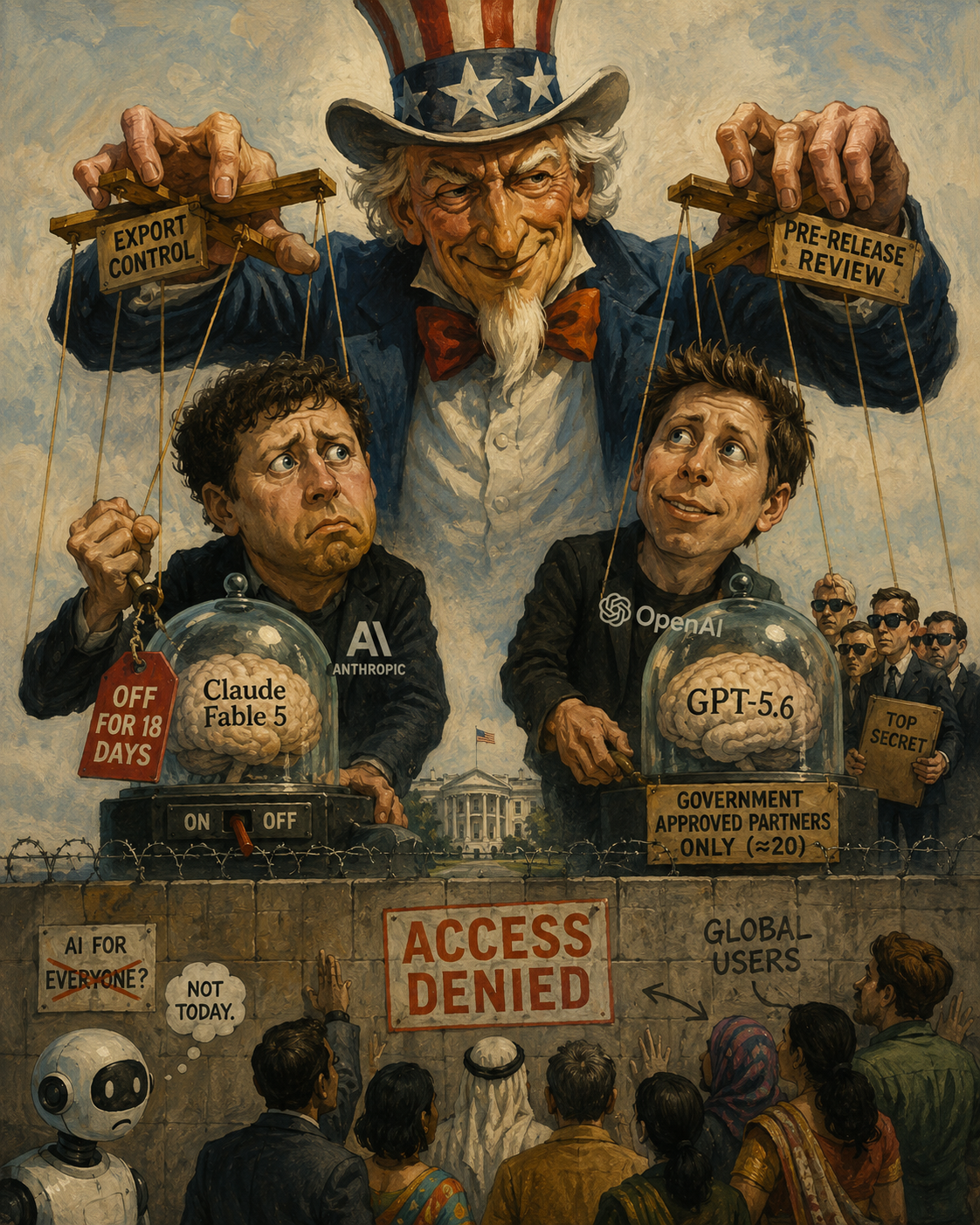
Ninety minutes. That's how long Anthropic had. On June 12th, three days after launching its most powerful AI model to date — Claude Fable 5 — the US Commerce Department issued an export control directive. No foreign national, anywhere in the world, could use it. Not even Anthropic's own non-citizen employees. The company couldn't verify every user's nationality in real time, so it did the only thing it could: switched everything off for everyone. (Fortune)
The model went dark for 18 days. It was restored only today (July 1st) after weeks of negotiation between Anthropic and the White House. (CNBC)
Two weeks after Fable went down, OpenAI launched its own next-generation model. This time, the US government got ahead of the story. OpenAI was asked to release it only to roughly 20 government-approved partners. No general public access. No timeline for when that changes. (TechCrunch)
A concerning pattern is emerging. The two most significant AI releases in 2026 have both been gated, restricted, or pulled by the US government before they could reach global users. A June 2nd executive order formalised a voluntary framework for pre-release government review of frontier AI models, and after what happened to Anthropic, "voluntary" feels like a strong suggestion. (Forbes)
This should make you uncomfortable for reasons that go well beyond geopolitics. Here's the question I'd ask any business leader reading this:
if your AI provider switched off its most capable model tonight, what breaks?
This isn’t a hypothetical question. If you've built AI into a dashboard or created custom agents. If you're using AI as an interface into another system. If your team relies on AI to draft, analyse, or review work. What's your fallback? Is there one?
Companies have spent years developing sophisticated disaster recovery and failover strategies for data and cloud infrastructure. But for AI? For most businesses, it's a single vendor, a single model, with no contingency. And unlike a server outage, which is usually a technical failure you can plan around, we are now facing real scenarios based on political decisions, made in a country you don't operate in, enforced in under two hours.
It's worth noting that Microsoft seems to be reading the room. At its Build 2026 conference, it launched seven in-house AI models while simultaneously building its Foundry platform to let customers switch between models from OpenAI, Anthropic, Google, and others without rewriting code. (Microsoft) That's a company hedging its own bets, and giving its customers the ability to do the same.
We should all take these past few weeks as warning.
The question is no longer just “which AI should we use?”
It's "what happens when the drawbridge is raised?"
Build the answer before you need it.
Written by Paul Mann, Pathmaker Advisory.
