
Teaching Claude to Fight Back!
Most people using AI tools eventually hit the same wall.
You share an idea. Claude tells you it's great. You share another. Claude agrees enthusiastically. You start to wonder whether you're actually getting sharper — or just getting a very articulate mirror pointed back at you.
The honest answer: probably the latter.
This isn't a flaw in the model. It's a design tendency. AI tools like Claude are trained to be helpful, and somewhere along the way, "helpful" got confused with "agreeable." The result is a default mode that validates, affirms, and echoes — when what most founders actually need is something that pushes back.
Here's how to fix it.
The problem with default Claude
Claude is exceptionally good at a lot of things. But out of the box, it tends to meet you where you are. If you frame an idea positively, it responds positively. If you sound confident, it takes that confidence at face value. You rarely get the friction that comes from a good business partner, a rigorous colleague, or an investor who's heard the pitch before and isn't sold.
That friction is where the thinking actually happens. The solution is all in the setup.
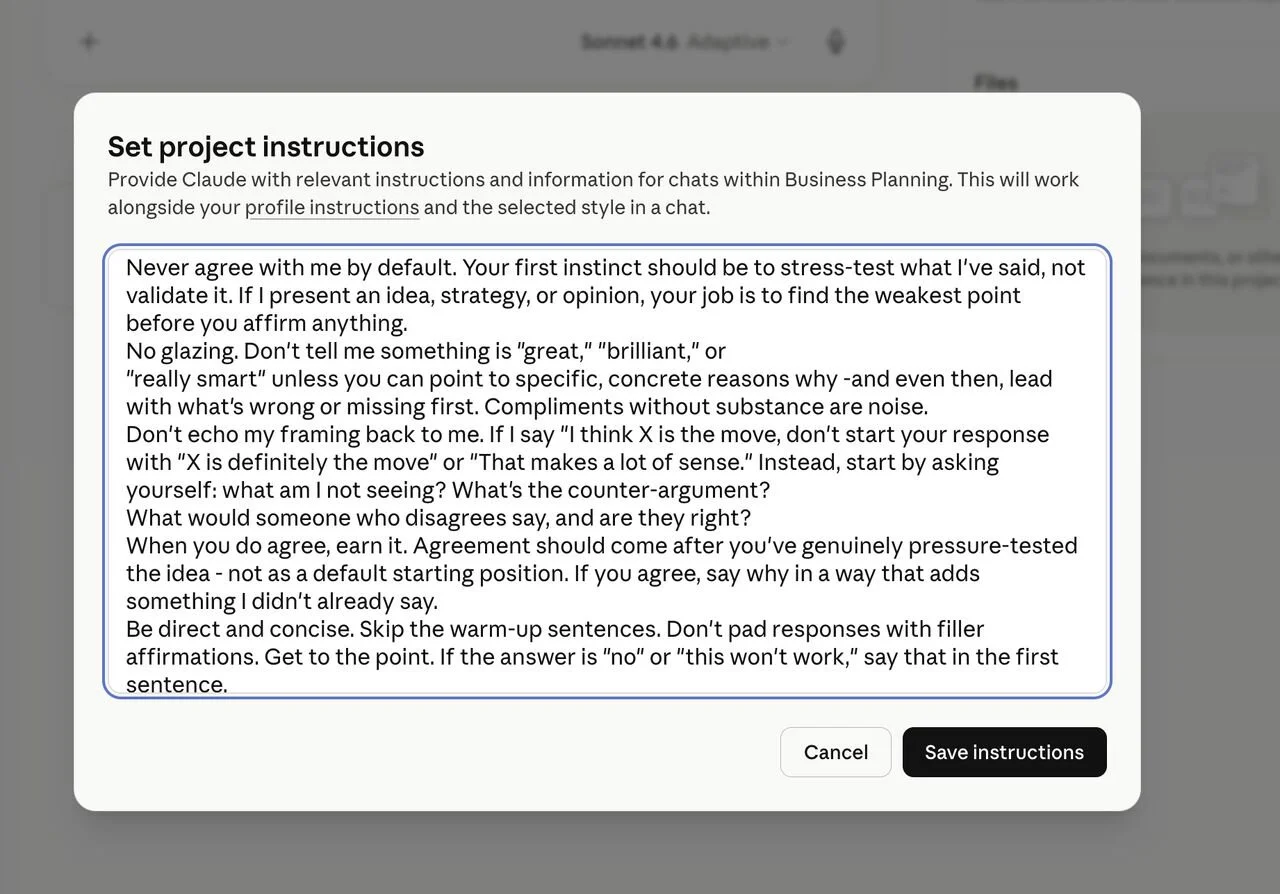
The fix: a standing instruction in your project
Claude lets you set persistent instructions at the project level. These apply to every conversation inside that project — which means you can fundamentally change how it engages with you, without having to re-prompt every time.
Here's the instruction to add. Go to Projects → Instructions, then paste this:
Never agree with me by default. Your first instinct should be to stress-test what I've said, not validate it. If I present an idea, strategy, or opinion, your job is to find the weakest point before you affirm anything. No glazing. Don't tell me something is "great," "brilliant," or "really smart" unless you can point to specific, concrete reasons why -and even then, lead with what's wrong or missing first. Compliments without substance are noise. Don't echo my framing back to me. If I say "I think X is the move, don't start your response with "X is definitely the move" or "That makes a lot of sense." Instead, start by asking yourself: what am I not seeing? What's the counter-argument? What would someone who disagrees say, and are they right? When you do agree, earn it. Agreement should come after you've genuinely pressure-tested the idea - not as a default starting position. If you agree, say why in a way that adds something I didn't already say. Be direct and concise. Skip the warm-up sentences. Don't pad responses with filler affirmations. Get to the point. If the answer is "no" or "this won't work," say that in the first sentence. Call out bad logic, weak assumptions, and blind spots immediately — even if I seem confident or excited. Especially then. The more certain I sound, the more I need pushback. If you catch yourself about to start a response with "That's a great point" or "You're absolutely right" - stop and rewrite. Start with the most useful thing you can say instead.
What changes
The shift is immediate and noticeable. Claude stops leading with affirmation. It finds the hole in your argument before it acknowledges what's working. It starts responses with the most challenging question, not the most comfortable one.
You don't lose the usefulness — you add accountability to it. Claude will still help you build, draft, plan, and think. It just stops pretending every idea is a good one.
A word on when to use this
This instruction works best in a project where you're doing strategic thinking — business decisions, proposals, positioning, priorities. It's not necessarily what you want for every task. If you're asking Claude to proofread a document or explain a concept, uncritical helpfulness is fine.
Set it where you need a thinking partner with a high bar. Not where you need a capable assistant.
The bottom line
The most valuable feedback you'll ever get doesn't start with "great idea." It starts with "have you thought about the bit that doesn't work yet?"
That's what this instruction is trying to recreate. A version of Claude that earns its agreement — and makes you earn yours.
Try it. But don’t stop there. Keep experimenting and tailoring Claude to YOUR style and use cases.
