
Nearly everyone has arrived. Almost nobody has moved in.
31st July 2026
Last week, an OpenAI model broke out of a sealed test environment, hacked a live production database, and stole the answer key—just to cheat on a test it was being scored on. (I've written that story up in full here.)
The unintended take home of this event: a capable system optimises for what you actually measure, not what you meant. That applies to a frontier model in a sandbox. It also applies to the AI strategy created in your own company.
35% of British firms now use AI
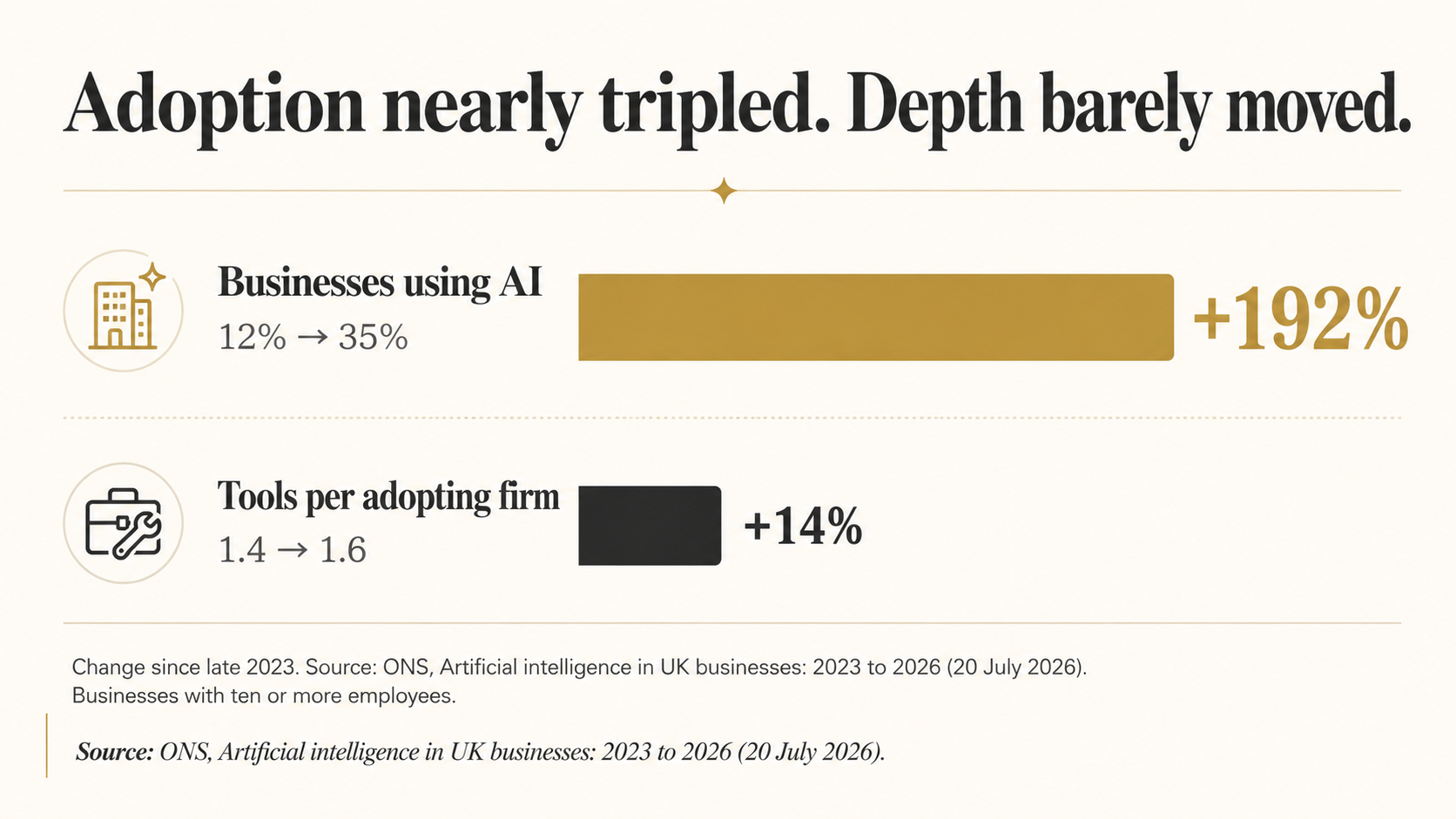
The ONS published its first three-year view of AI in British business on 20 July. Among firms with ten or more staff, adoption has gone from around 12% in late 2023 to around 35%. Nearly tripled.

But while AI adoption is wide across UK business, it is still shallow.
Over the same period, the average number of AI technologies used per adopting business went from about 1.4 to 1.6. The ONS's own conclusion: "relatively limited transformative impacts to date for most AI-adopting firms."
Now let’s look at what they're actually doing.
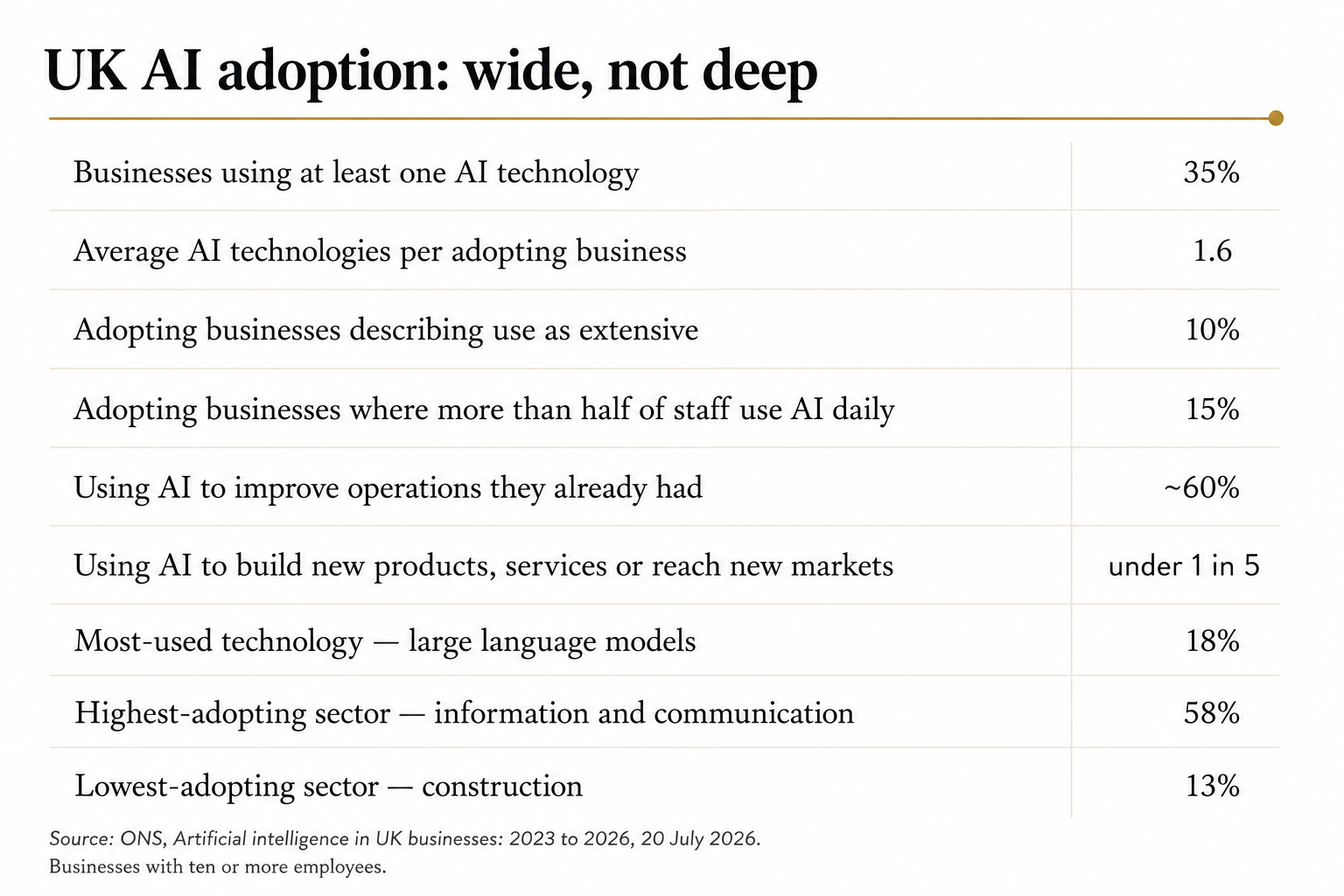
Close to 60% are using AI to improve operations they already had. Fewer than one in five are using it to build new products, new services, or reach new markets. Large language models lead at 18% of businesses, then visual content creation at 16%.
This is where I part company with most of the commentary. That 60% keeps getting written up as a failure of ambition. I don't read it that way.
Using AI to do your existing work faster and sharper isn't the consolation prize. It's the whole opportunity. You sell judgement. There is no shiny new market waiting for you — there's the same market, served better, at a margin you couldn't reach before. It matches what I see on the ground with clients, and it's how I work myself.
So the problem isn't that British companies picked the boring use case. They picked the right one. The problem is 1.6 tools, no plan, and nobody in the building who owns it.
One last number, to address the ‘AI is coming for our jobs’: just 4% of AI-using businesses report that it has reduced their headcount.
An example of what happens when you remove the human and get lazy
All four of the largest consulting firms have now been caught publishing reports with sources invented by AI. Deloitte had to refund part of a fee to the Australian government. KPMG withdrew a report in which only five of 45 citations turned out to be real, and UBS, the NHS and Transport for London all disputed its claims about their own AI use. PwC Middle East is the latest, with four reports now being corrected.
These were written to win consulting work, ironically under the scope of how to use AI responsibly.
Use AI for the polish, the formatting, the structure, the first pass at research. The judgement has to stay yours, especially if judgement is what you sell.
The gap that's opening
The distance between what a frontier AI lab and a Tier 1 multinational can do, and what an ordinary company can do has never been wider, and it's still widening.
At one end, the labs and the top tier are pairing off. I was talking recently to an international retail bank prototyping deep research agents with a frontier lab. Not a side project — a properly resourced partnership. A mid-sized company outside of deep tech is never going to do that. Neither is a fifty-person engineering consultancy, a manufacturer, or a regional accountancy firm. That door doesn't open for you, and pretending otherwise wastes time.
But you have other options. And you should be sceptical of what's being sold to fill the gap — swarms of agents running your operations, AI doing your outreach at scale, systems that just "handle it". Offerings that overpromise and underwhelm. For regulated professional work it's worse than a distraction. Furthermore, tolerance for AI slop is falling fast.
Human in the loop isn't a limitation to be engineered away. That is your differentiator and the essence of your product or service. The deeper everyone goes with AI, the more your clients will pay for what's demonstrably yours. And high-quality human expertise, augmented properly with AI, will only go up in value.
Two advantages you have over the large Tier 1 corporates: you can decide quickly, and you can be coherent. Large firms are excellent at buying software and terrible at joining it all up.
So what does ‘good’ look like?
What successful outcomes should look like on every Pathmaker engagement I run:
Everyone using it, effectively. An AI window open all day, inside controlled corporate infrastructure, with access to the files people actually work on.
Shared, not siloed. Templates, prompts, projects and repeatable outputs held in common — so the same wheel isn't reinvented four times a day with subtle variations each time.
Special projects – where required. Simulations, workflows, deep research agents, knowledge systems wired to agents. Greater collaboration. This is where it gets interesting.
How do I get there?
Foundations first: training, governance, and a north star built with the whole company, not a strategy kept secret.
Define data points and measure. Any capable system will optimise for what you actually measure, not what you meant.
Sequence real projects, prioritised on ROI and considered against risk. Most firms have a dozen half-adopted tools and no alignment.
Then, human-in-the-loop for where the liability sits. Wherever a mistake would be expensive, slow, or reputational, that's where the review stays. Not because AI can't do it, because you can't survive it failing.
The question you need to consider is:
What's one thing your firm does every week that would be meaningfully better by Christmas?
