
The Missing Ingredient in Your AI Strategy
3rd September 2026
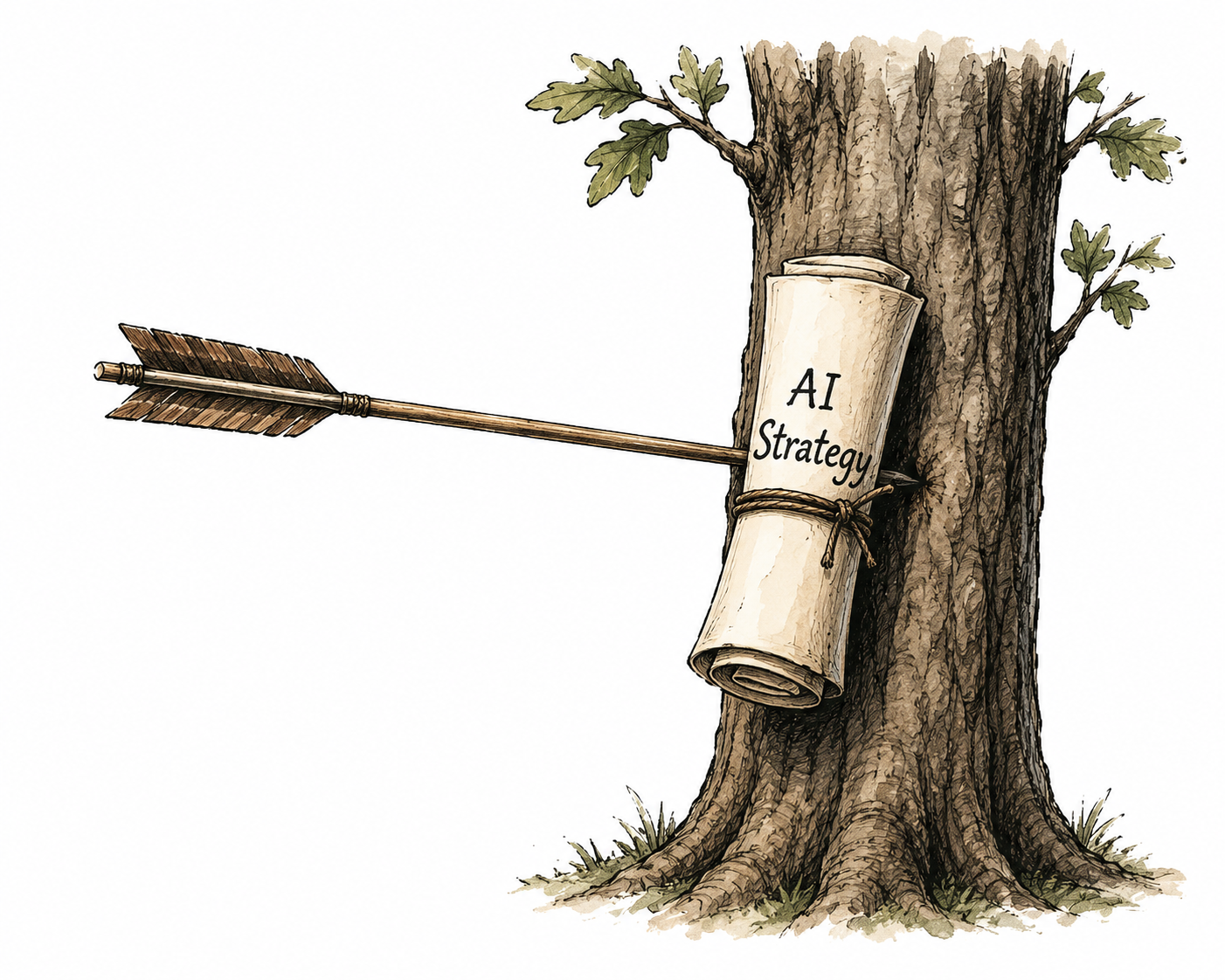
How to avoid the "AI overload" trap and turn strategic restraint into a competitive advantage.
Somewhere in the last twelve months, the question changed.
ChatGPT arrived in November 2022, and the strategy question in every boardroom was: what can we do with AI? But more recently, that question has quietly changed to: what should we do with AI? That is a much harder question to answer.
AI is just so malleable that it can touch almost any part of your business, and the noise around it makes every use case idea sound urgent and compelling, leaving many companies paralysed with indecision. Prioritises get confused, and any talk of AI Strategy gets lost. Talk of training, rollout and transition get skipped as a ‘nice to have’.
The temptation is to collect as many AI use cases as possible and urgently adopt them faster than your competitors.
That is where most businesses are today.
Buyer's remorse
Here is the pattern I keep seeing, and it runs against the direction of most commentary.
Companies that rushed to ‘AI-ify’ all of their products, services or their communications, - are quietly discovering one (or more) of these three things:
the market or their staff weren't ready,
the market or their staff never wanted it, or
the market or their staff may never want it.
It boils down to an internal or external alignment problem. The resulting failure is expensive, and very few will say so publicly.
When and where should you use AI?
I am a Star Wars fan. Do you remember The Phantom Menace from 1999? The studios had clearly just received the keys to a new generation of CGI (Computer-Generated Imagery) capability. Their instinct? Full throttle – as much next-gen CGI as possible. The film was still good, but it suffered from that choice. Luckily, the strength of the Star Wars canon meant the film survived.
Then, in 2015, The Force Awakens started a new era for the franchise. A defining feature was the move to ‘back to basics’ - back to physical models, practical effects, and engineering, using CGI as little as possible. They dusted off the 1980s creature-shop methods for the aliens and monsters, and it worked beautifully.
The lesson wasn’t the capability itself, but instead the judgement about when to use it.
Any AI Strategy needs human expertise at its core
Regardless of your expertise or output (film included), I have three predictions:
The deeper we go into AI, the more valuable real human expertise becomes.
Over the next decade, the pool of that expertise shrinks. More people lean on AI as it becomes more capable, and fewer come up through the career paths that produce real-world experience and the market value attached to it.
A renaissance in the humanities and social sciences. We are currently watching these disciplines shrink, mainly due to current politics and failures in academia. But it may be the case that we need them more than ever! I am talking about critical thinking: judgement, interpretation, argument, and knowing what a source actually says. That is the exact skillset responsible AI design and good AI implementation require.
Ethan Mollick, a professor at Wharton and one of the more sober voices in the AI field, argues that an AI future requires us to build our own expertise as human experts. His reasoning: experts get more from AI because they can fact-check the output and correct the errors.
Headlines from the study: Harvard Business School researchers, working with BCG, ran a field experiment across 758 consultants. On tasks the model handled well, consultants using GPT-4 completed roughly 12% more work, around 25% faster, and at measurably higher quality.
Then the researchers gave them one task placed just outside the model's competence. On that task, the AI-assisted group were 19 percentage points less likely to reach the right answer than the control group.
The tool gave no warning. It was confident, fluent, and wrong, and experienced consultants didn’t spot this.
This is the classic AI failure example. There was no obvious or visible failure. That is the problem. You get a plausible output, quietly going out under your name to a client. A horror story for any leadership team to deal with.
The Big 4’s expensive blind spot
The Big 4 have already fallen on this hurdle – and more than once.
Deloitte refunded part of an Australian government contract in October 2025 over a report containing fabricated references and a quote invented from a court judgment. EY withdrew a study in May 2026 after fabricated citations were found in it. KPMG's flagship agentic AI report was found to have the large majority of its 45 citations corrupted or fake. PwC has since had thought-leadership reports flagged for hallucinated citations and unverifiable claims. And these are the firms that sell AI governance for a living!
Where the actual opportunity is
Outside deep tech, most UK businesses are using AI to tidy up emails and ask questions in a chat window. I suspect over the next 18 months, this type of usage will become ubiquitous. Regardless, your competitors will certainly be using AI like this even if you are not.
The firms that pull ahead will be the ones that make strong strategic choices against high-value with compounding opportunities. The AI will be built around how their people already work, and set clear boundaries about what stays human and why. They will have thought long and hard about what differentiates them from the pack and embedded this hard into their AI Strategy. And I guarantee, for the market leaders, a strong part of their strategy will remain human expertise.
Just because you can do something with AI, doesn't mean you should. Working out which is which—with structure, evidence, and commercial sense—is exactly what Pathmaker does.
