
Whack-a-Mole Is Not an AI Strategy
1st October 2026Why most AI rollouts stall, and how to keep yours moving.
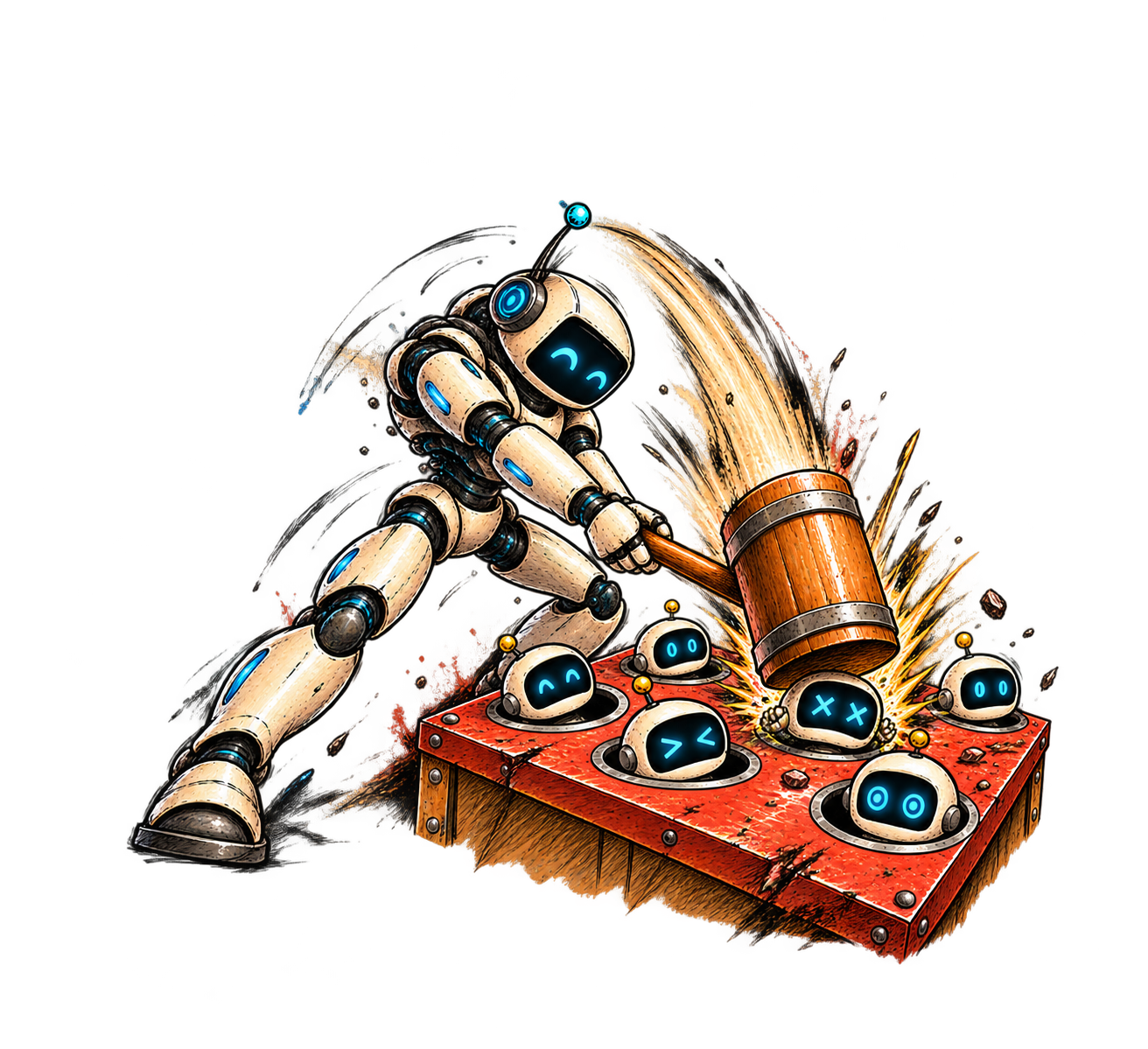
A client forwards me a use case they spotted on LinkedIn on a Friday afternoon. By Monday it's a priority. By Wednesday there's a big update from Anthropic and a new model, then on Thursday there's a great use case from YouTube, or from a favourite influencer.
That's whack-a-mole.
Every mole feels real and relevant, and every whack feels productive. But at the end of the year you've got a sore arm and no idea where you've been!
I live and breathe this stuff, through research, real-world client and business experience, tutorials from the AI labs and development partners with advanced degrees in data science and AI, and I still find the pace overwhelming. Most of what comes out won't be relevant to your business. That much I can guarantee.
An AI strategy tells you which bits are relevant. It gives you that North Star. You pick the goals, pursue them relentlessly, and install triggers and waypoints so you can change course when something genuinely shifts. Forget chases the latest releases. Pick a whale and really wrestle with it.
Strategy also forces you to think about sequencing. Most firms already have a shortlist of AI use cases they want to pursue. But often the elephant in the room is what sits underneath: where the data lives, how many systems are involved, and what state it's in. The best-built agent is useless without the right data in place that is properly structured. Skip the plumbing and you'll hit a wall.
So, blend a few confidence-building quick wins with one meaty problem that moves the needle.
But before anything gets built, ask three questions:
Can an existing tool do this already?
Is a vendor likely to add a feature soon that will help?
Is this a process or technology problem?
And be willing to let go of software that was the right call a while back but isn't now.
Training is step one, not the finish line
Once you have a direction, training is where any rollout starts. Run workshops team by team and ideas start spilling out. People feel they have permission to experiment. More than once, someone has told me, with genuine relief, that they'd been told to "just have a play with it" when what they needed was to see it work in their own world.
But most firms stop too early. They roll out licences in response to a mandate from the board, and everything else is just a bit too ‘flappy’. Training is generic. The AI strategy, if there is one, hasn't been shared with the people expected to deliver it. Nobody tries to shift the culture. Good training is tailored to each team's actual work, tied to the strategy, and repeated as the tools change.
Vibe coding: brilliant in the sandbox
Now the fun bit. Vibe coding, what is it? It is Building software by describing what you want in plain English, conversationally and iteratively. No coding experience required. In my last business, I paid around £12,000 for a bespoke CRM. Recently I built one over a weekend using Claude Code.
Vibe coding is the fastest way to test an idea and find out whether it deserves proper investment, even if the prototype ends up in the bin. Or, it could be that a vibe coded solution is all you need at the moment.
But recognise the limits, especially if you're regulated. If an expenses agent gets something wrong, you'll probably notice it before any damage is done. An agent reconciling a large number of accounts or preparing complex tax figures can be confidently wrong in ways you won't notice until it matters.
And what works today doesn't always work tomorrow. My own custom instructions worked beautifully in Claude until something shifted in the model, and suddenly it wouldn't let an argument go, like a dog that refuses to drop the stick. I noticed because it was driving me mad! A shared agent that quietly starts giving different answers won't be so obliging. And when its builder leaves, any knowledge of the design is gone.
Going multiplayer
Single-player AI is everyone with their own assistant, prompts and agents. Multiplayer AI is when those tools become shared, vetted and trusted across teams, each building on what the last one learned. Multiplayer AI is how to change a firm at a fundamental level, to instigate serious change with a compounding effect.
The trick is to keep the entrepreneurial energy while giving it a route into the business. Let people build locally. Then check the data, compliance and usage before anything is released more widely, and give credit where it's due, whether that's recognition, tokens or a bit of swag.
It matters because errors compound at scale. An agent that gets each step right 99% of the time is probably fine as a personal assistant, but a serious problem when operating at enterprise level.
When the stakes go up, build it properly
Anything that touches money, regulatory reporting or advice goes to people who build agents for a living.
You prove the idea. An engineer turns it into something that feels like an app: it pops up, does its job, and nobody can fiddle with it.
Under the bonnet, that means a tested method, guard rails, checks that catch the model drifting before your clients do, and clean, defined data. What you get is answers you can audit and a tool that keeps working when its builder moves on.
Professional builds also stop your best people disappearing down vibe-coding rabbit holes when their day job pays the bills.
But don't forget to close the loop: every new tool goes back through training, so it lands with the people who'll use and adopt it.
Strategy and sequence keep the wheels turning
Read that journey back and you can see how easily it goes wrong. Training without strategy plateaus. Vibe coding without strategy sprawls. Multiplayer AI without strategy is just more moles, arriving faster. What does work is is bite-sized cycles involving all of these components. You might have a hundred use cases. Take ten, build them, and bring them to a review where people with real authority decide what goes live and what comes next.
The bottom line
Let us be clear. Boards have signed off the licences, but in most cases, AI has quietly settled into being a rather expensive way to draft emails.
That is not a failure of technology. It is a leadership problem, dressed up as something else:
"The tools aren't ready." "Our data isn't there yet." "We're waiting to see what Microsoft does next."
Each excuse sounds reasonable. Together they add up to a policy of waiting, and waiting is not a strategy.
Anyone can buy Copilot, and your competitors already have.
The advantage goes to leaders who decided what AI was for in their business, got the sequence right, and ignored the release FOMO.
The novelty has worn off. The question for every board is no longer whether to use AI, but who owns it, and what they've been told to deliver by this time next year.
